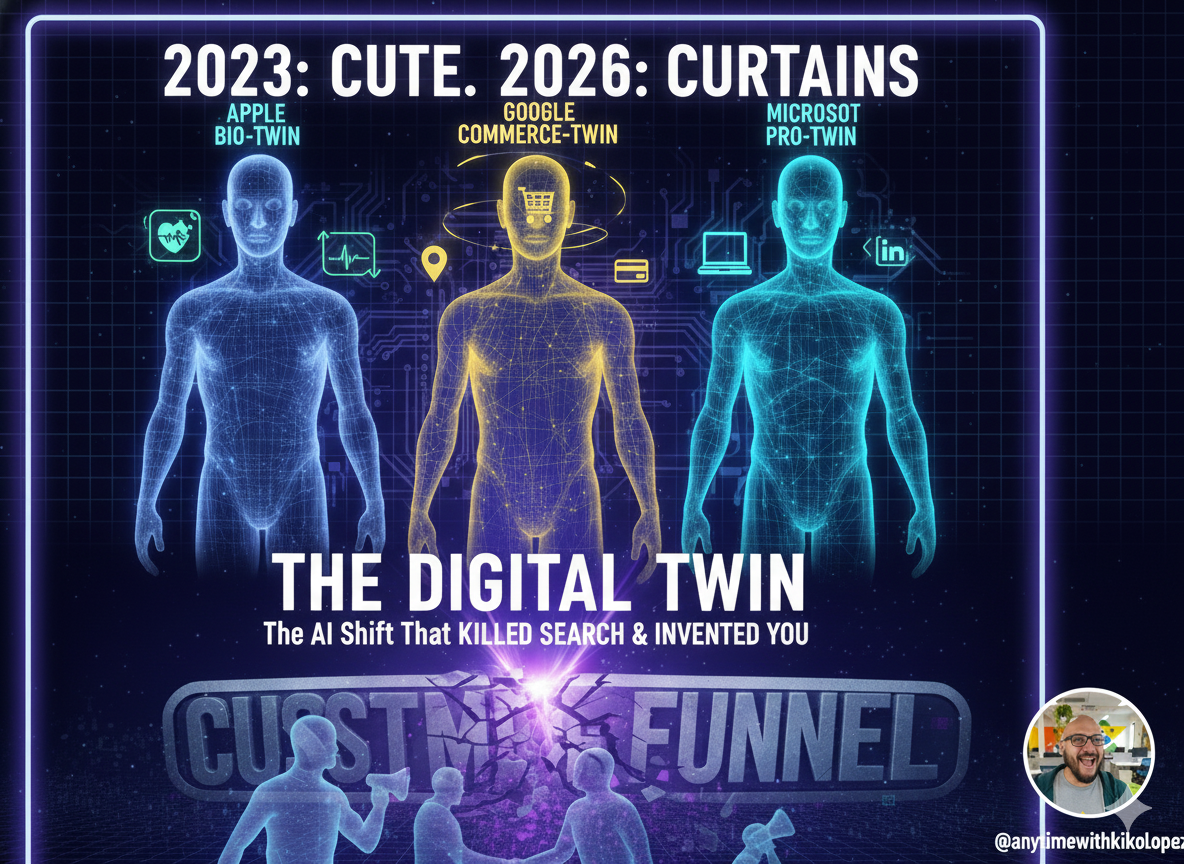
The "Post-Human" Funnel: Why Your 2026 Marketing Strategy is Yelling into a Void
Welcome to 2026, where your marketing funnel didn’t just shrink—it vanished. We’ve officially graduated from the 'Assistant Era' into the world of Digital Twins: persistent, always-on silicon versions of your customers that make buying decisions while the humans are still making coffee. If your brand isn’t machine-readable, you’re invisible to the only customer that matters. From Apple’s Bio-Twin to Google’s Commerce-Twin, discover why 'Inference Share' is the only KPI that counts in a world where machines do the shopping.

Being Human Is a Skill (Most Brands Don’t Have It)
The "Patagonia Vest" Problem
In a world drowning in polished automation and AI-generated noise, being human has become a competitive edge. Yet, most brands still sound like they were written by a committee of tax auditors wearing Patagonia vests.
“Due to recent updates in our strategic synergy alignment…”
Brother… please. Touch some grass.
The reality is that in the Attention Economy, feeling > information. Brands avoid humanity because they fear getting "weird" or sounding "unprofessional." But "different" is the only way an LLM distinguishes your voice from a million others.
It’s the difference between:
Corporate: “We strive to deliver customer-centric solutions that drive optimized outcomes.”
Human: “We built this because the old way sucks.”
One gets ignored. One gets remembered. Being human isn't the risk—being forgettable is.
Why this works as an excerpt:
The Hook: It uses your strongest visual imagery (the tax auditors) to create an immediate mental picture.
The Contrast: It highlights the "Corporate vs. Human" comparison, which provides instant value and "aha" moments.
The Stakes: It frames humanity as a survival tactic against AI noise, making it timely and urgent.

The Three-Course Meal Method of Storytelling
Stop feeding your audience facts and start serving them a feast. Most content fails because it’s a pile of ingredients with no recipe. The Three-Course Meal Method changes that. From the "holy sh*t" appetizer that hooks the senses to the emotional dessert that sticks to the ribs, this framework turns your message into something digestible, memorable, and impossible to ignore. Because at the end of the day, humans don’t process information—we process stories.

Your Brand Isn’t Confusing — It’s Probably Just Boring (AF)
Whenever a brand isn’t performing, someone inevitably says, “I think our messaging is confusing.”
No, it’s not. It’s boring.
Confusion can be fixed. Boredom is deeper — it’s emotional. Your brand isn't getting ignored because people don’t understand it; it’s getting ignored because people don’t feel anything from it.
Boring Is the Most Expensive Mistake in Marketing. Boring costs Engagement, Sales, Loyalty, and Attention, which is the new currency.
Brands default to boring because they’re scared:
Scared to be bold.
Scared to stand out.
Scared to have a personality.
Safety is the quickest way to become invisible.
The Fix: Add Stakes
Stakes make messages interesting. Ask yourself:
What does my audience gain?
What do they lose?
Where’s the emotional tension?
If there’s no tension, there’s no attention.
The Truth: You don’t need to be louder. You just need to be more interesting.

Emotional Intelligence: Marketing’s Secret Weapon
Marketers love to talk about IQ: Metrics, data, funnels, and segmentation. “How can we improve our CTR by 0.5% in Q4?”
Which is cool, but if you don’t understand humans, none of that matters. The future of marketing belongs to the emotionally intelligent — the people who understand not just what audiences do, but why they do it.
What EQ Actually Means in Marketing
It’s the ability to:
Read your audience
Anticipate their reactions
Understand their fears
Speak their emotional language
EQ is the difference between a brand saying:
“Improve productivity with our SaaS platform”
and
“You won’t dread opening your laptop tomorrow.”
One is a pitch. The other is a promise.
The Power of Emotional Truth
Great marketing taps into emotional truth — the stuff people rarely say out loud but always feel. You have to understand what keeps them up at night, what frustrates them, and what they wish someone would finally acknowledge.
When you hit emotional truth, you bypass logic entirely. You hit the limbic system — the part of the brain that drives behavior.
Why EQ Beats Data Alone
Data tells you what happened. EQ tells you why it happened — and what will happen next. Data is the map. EQ is the compass. And when the world changes fast (and it is), a compass beats a map every time.
Consumers don’t want perfect brands. They want human brands. And if you want to build one? EQ is your superpower.

Stop Talking About Your Product. Tell Me Why I Should Care.
Stop leading with product features. People don't buy stainless steel bodies or AI-powered automation—they buy feelings. Whether it's the promise of an ice-cold beer on a hot day, getting their evenings back, or finding relief from 3 AM spiral thinking, every purchase is driven by an emotional outcome. If your marketing doesn't tap into one of the five core emotional buckets (Freedom, Confidence, Relief, Identity, Escape), you're writing a brochure, not a compelling message, and your brand will be ignored. Learn how to translate features into powerful, persuasive feelings.